Sacred Resins: The Recipe
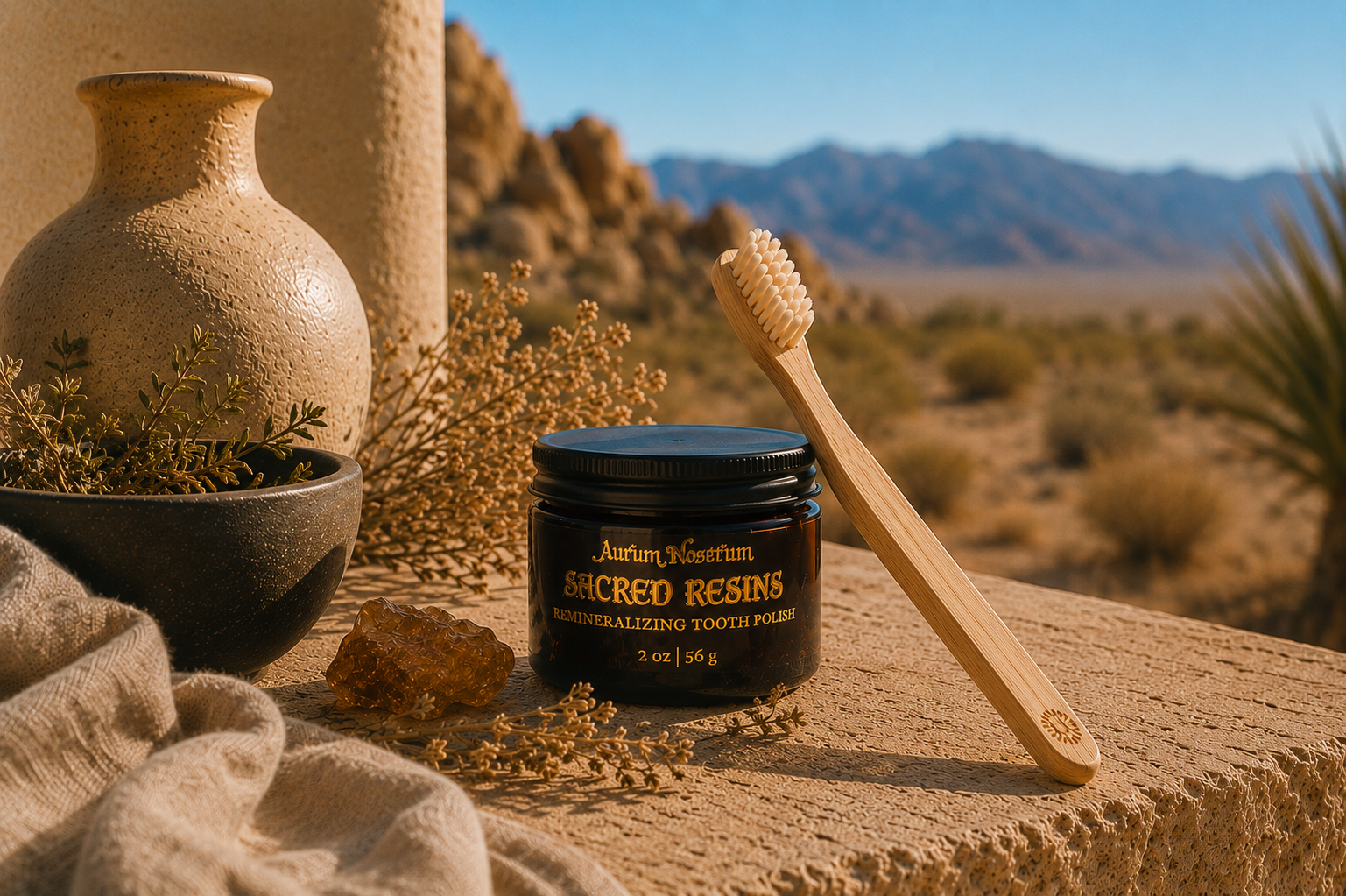
Knowledge encoded in plants, minerals, and ritual.
When I started Aurum Nostrum, I made a promise: the gold is the knowledge, and knowledge hoarded is knowledge that dies.
So here it is! The complete formula for Sacred Resins, our remineralizing toothpaste, with everything I've learned about why each ingredient is in the jar. Make it yourself, change it, pass it on. That's the whole point.
If you'd rather have it made for you, it's available in the shop.
From the Temple to the Bathroom Sink
Toothpaste is one of the oldest recipes humans have. A fourth-century Egyptian papyrus, held today in Vienna, records a formula for "powder for white and perfect teeth" — rock salt, mint, dried iris flower, pepper. The Romans scrubbed with powdered chalk. Across the Arabian peninsula and North Africa, people have cleaned their teeth with the miswak — a teeth-cleaning twig from the Salvadora persica tree — for thousands of years, a practice that continues today.
And through all of it, two resins kept appearing wherever humans took care of their bodies and their dead: frankincense and myrrh.
These were not casual ingredients. They were burned in temples from Egypt to Jerusalem. Frankincense traveled trade routes so valuable they shaped empires. Myrrh sealed the bodies of pharaohs. Both were medicine (chewed, tinctured, applied to wounds and gums) long before they were ever symbols.
Every generation decides what it preserves and what it allows to fade. Most of this knowledge faded from the shelf, replaced by formulas optimized for cost and patent protection. It never faded from the record. It was sitting in the archive the whole time, waiting for someone to walk back in.
The Ingredients, and Why
-
Frankincense (Boswellia resin) — the heart of the formula and the source of its name. Frankincense resin contains boswellic acids, studied in modern research for their anti-inflammatory activity, and it has been chewed as a gum-cleansing resin in traditional practice across the regions where Boswellia trees grow. Temple incense, trade gold, mouth medicine. The same substance, three jobs, three thousand years.
-
Myrrh (Commiphora resin) — frankincense's ancient companion. Myrrh tincture for the gums appears in old Western pharmacopeias and remains in use in traditional and herbal dentistry. Astringent, aromatic, and historically inseparable from the practice of preservation — the Egyptians built mummification around it. Both resins enter this formula as their essential oils — the distilled voice of the resin, counted in drops.
-
Hydroxyapatite — the modern key. This is the mineral that makes up roughly 97% of your tooth enamel, and in toothpaste it supplies the very material teeth are built from. The research story is its own parallel-system parable: hydroxyapatite toothpaste was developed and brought to market in Japan decades ago, where it became an established alternative to fluoride — while Western shelves are only catching up now. Knowledge moves; industries decide whether to follow.
-
Calcium carbonate — the oldest tooth-cleaning mineral in recorded history. This is, essentially, refined chalk: a gentle abrasive that polishes without scouring. The Romans would recognize it.
-
Bentonite clay — aged volcanic ash, used in traditional cleansing practices for its drawing and polishing properties. It gives the paste body and a soft, earthen texture.
-
Xylitol — a sugar alcohol originally derived from birch, made famous by decades of Finnish dental research. The bacteria that cause decay cannot metabolize it. Sweetness that the mouth's troublemakers can't use is a quiet, elegant trick.
-
Clove — the dentist's spice. Clove oil's active compound, eugenol, has been used in dentistry for generations as an analgesic and antimicrobial; the smell of it is practically the smell of oral care history.
-
Ceylon cinnamon, peppermint, and vanilla — warmth, brightness, and depth. The cinnamon is Cinnamomum verum — true cinnamon, softer and rounder than the common Cassia. The vanilla is our own extract — beans steeping in good vodka since February. Patient and irreplaceable. Together they make the paste taste like something made by a person, because it was.
-
Coconut oil, two ways — hydrogenated for structure, fractionated for slip. The pairing is a desert lesson: the first version of this formula, built on ordinary coconut oil, went liquid before it reached the jar in the Mojave heat. Three iterations later, the texture survives the climate it was made in.
-
Baking soda — alkaline, so it neutralizes the acids that erode enamel, and a fixture of home oral care for well over a century. Commercial brands eventually added it back into their formulas and marketed it as innovation. It had never been absent from the homes of anyone who was paying attention.
-
Coco glycoside — the plant-derived surfactant that gives the paste its gentle lather. It is what foam looks like when it isn't sodium lauryl sulfate: it cleans, it foams softly, and it does its job without irritating the tissue it touches.
The Recipe
Sacred Resins Toothpaste — home batch, makes two jars (~160g)
Hydrogenated coconut oil — 30g
Fractionated coconut oil — 19g
Calcium carbonate — 30g
Hydroxyapatite — 14g
Bentonite clay — 19g
Xylitol — 22.5g
Baking soda — 12.5g
Coco glycoside — 14g
Ceylon cinnamon powder — 2.5g
Peppermint essential oil — 63 drops
Frankincense essential oil — 16 drops
Myrrh essential oil — 16 drops
Clove essential oil — 16 drops
Vanilla extract — ¾ teaspoon
Method
Melt the hydrogenated coconut oil gently in a double boiler. Once fully liquid, add the fractionated coconut oil.
Dissolve the xylitol completely into the warm oil. This is the step that determines texture — xylitol that hasn't fully dissolved will re-crystallize as the paste cools, producing the graininess that gives homemade toothpaste a bad name. Take your time. Let it disappear.
Separately, sift and grind the dry ingredients together until completely uniform: calcium carbonate, hydroxyapatite, bentonite clay, baking soda, and Ceylon cinnamon.
Remove the oil from heat and let it cool until warm but no longer hot. Work the dry blend in gradually, stirring continuously, until the paste begins to form.
Fold in the coco glycoside.
The oils, counted in drops: peppermint first, then clove, frankincense, and myrrh. Vanilla last.
Into the jar immediately, before it sets.
A few notes that apply no matter how you adjust it:
Use a non-metal bowl and utensil when working with bentonite clay — prolonged metal contact diminishes its drawing properties.
Essential oils in the mouth are a place for restraint, not enthusiasm. Measure in drops, not pours — the counts above are deliberate.
This is an anhydrous (water-free) formula, which is what keeps it shelf-stable without preservatives. Keep water out of the jar: use a clean, dry scoop rather than dipping a wet brush.
Store away from direct heat. The hydrogenated coconut oil holds the texture through warm weather, but it has limits — desert summers included.
Watch the Video
Because the recipe was never ours to begin with. It belongs to the Egyptian scribe with the pepper and iris powder, the Roman with the chalk, the herbalist with the myrrh tincture, the Japanese researchers who put enamel's own mineral into a paste. We assembled it, tested it, and wrote it down — which is all anyone in this lineage has ever done.
Aurum Nostrum Non Est Aurum Vulgi. Our gold is not the common gold. The gold is the knowledge — and gold like this only keeps its value in circulation.
Make it. Share it. Tell us what you changed.
This post describes a cosmetic preparation for cleaning teeth; it is not medical or dental advice, and nothing here is intended to diagnose, treat, cure, or prevent any disease. If you have dental concerns, see your dentist — and tell them what you're using.